
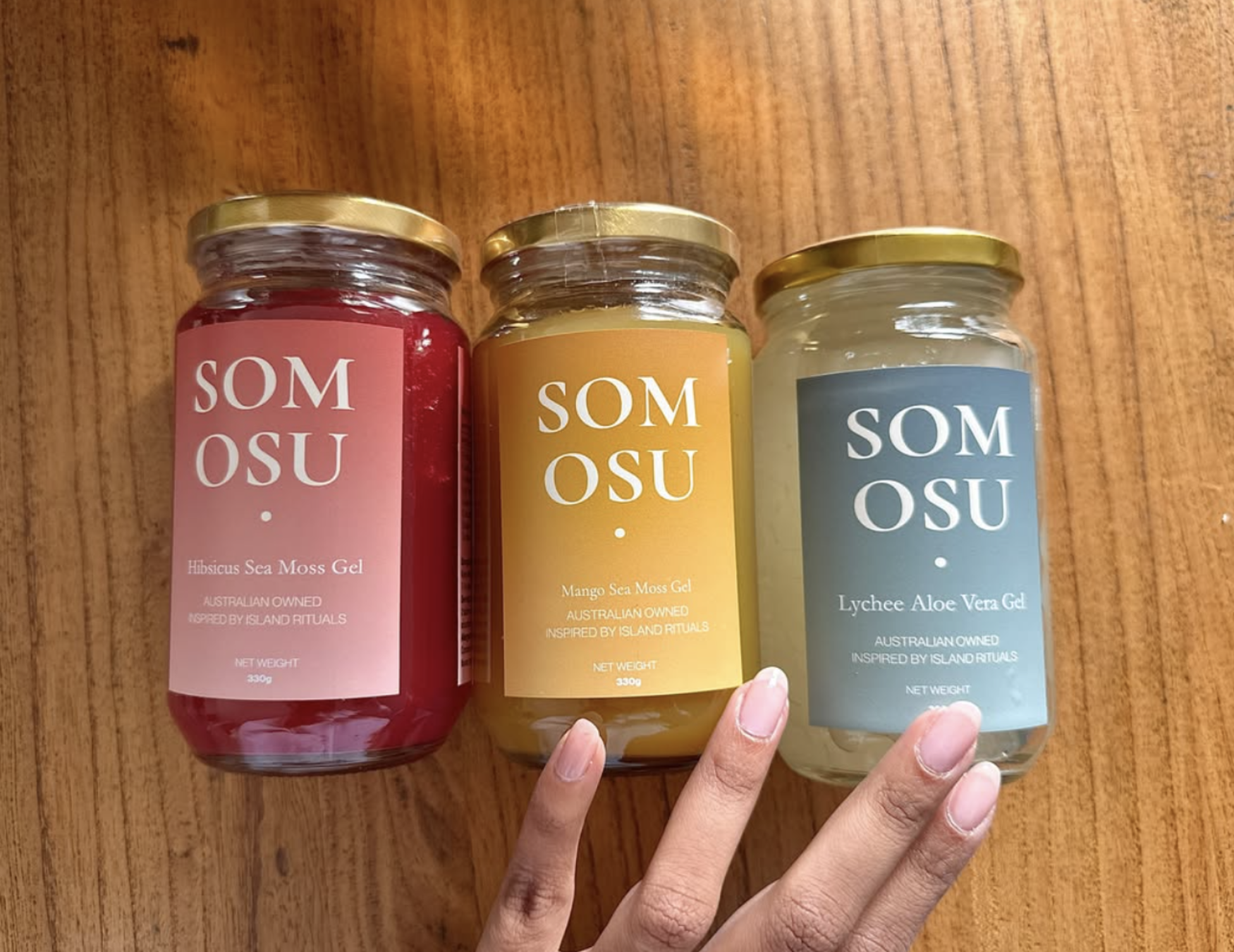
Sea moss has had quite the PR moment. We thought it was time to get properly acquainted.
At what point did we collectively decide that eating sea moss by the spoonful was a perfectly normal thing to do?
Not that we're complaining. We've built an entire collection around it.
Somewhere along the way, sea moss went from a relatively unfamiliar ingredient to something everyone seemed to have an opinion on. Some people swear by it, others are still figuring out what it is, and the rest of us are wondering whether we're supposed to be adding it to our smoothies.
The funny thing is, sea moss has been around a lot longer than the conversation surrounding it.
And for something that's received so much attention, there's still quite a bit we don't talk about. Like the fact that sea moss isn't one specific species, that different varieties have different properties, and that the type you're eating actually matters.
When I first started developing SOM OSU, I became particularly interested in one variety: Kappaphycus alvarezii.
A tropical red seaweed with a rather complicated name, some fascinating natural properties and, as it turns out, a lot of potential in the kitchen.
So, before we get into the Mango and Hibiscus of it all, let's start at the beginning.
First things first. Sea moss isn't actually moss.
A slightly misleading name, if you ask me.
Sea moss is a common name used for several species of edible red algae found in marine environments around the world. Some grow in cooler Atlantic waters, while others thrive in warmer tropical regions.
And while the internet might have you believe sea moss was discovered sometime between the rise of green smoothies and the clean-girl aesthetic, seaweed has been part of food cultures for centuries.
Across Asia, the Caribbean and other coastal communities, different varieties have long been incorporated into drinks, desserts, soups and everyday cooking.
The ingredient isn't new. What's changed is how we're discovering it, talking about it and finding new ways to enjoy it.
Not all sea moss is the same. Who knew?
The term 'sea moss' is often used as though it refers to one particular ingredient. In reality, it can describe several different species of red algae.
Take Irish moss, scientifically known as Chondrus crispus. Found predominantly along cooler Atlantic coastlines, it's one of the better-known varieties.
Then there's Kappaphycus alvarezii.
Cultivated in warm tropical waters, particularly throughout parts of Asia, Kappaphycus is a red seaweed known for its naturally occurring kappa-carrageenan.
Carrageenan is a marine polysaccharide, a complex carbohydrate that contributes to the seaweed's ability to form a gel.
Essentially, it's part of what gives Kappaphycus that distinctive jelly-like texture.
Different species have different compositions, growing environments and physical properties. Even the finished texture can vary depending on the variety and how it's prepared.
Which is why knowing what kind of sea moss you're consuming is a rather good place to start.
So, why Kappaphycus?
For our first collection at SOM OSU, I knew I wanted to explore ingredients that could be sourced and developed through Sri Lanka.
I was interested in foods that might be familiar in one part of the world but relatively unknown in another. And more than anything, I wanted to see what we could create with them.
Kappaphycus caught our attention for its texture, versatility and distinctive natural properties.
Working alongside our food scientist and supplier partners, we developed a formulation containing a higher proportion of seaweed relative to water.
The result? A firmer, more structured gel rather than the loose, almost liquid consistency you might have seen in other sea moss products.
Ours is a little more jelly-like.
Very much intentional.
We wanted to preserve the distinctive character of the ingredient while creating something that could be enjoyed in different ways.
Of course, texture is personal. If you prefer your sea moss softer, a thorough stir with a clean spoon can help loosen the gel.
A small detail, but one worth knowing before your first spoonful.
The science behind the seaweed.
For all the attention sea moss receives, surprisingly little of the conversation distinguishes between the different species.
And that's where things get interesting.
Kappaphycus alvarezii has been studied for its mineral composition, dietary fibre and naturally occurring marine polysaccharides.
Research has identified minerals including calcium, magnesium, potassium and iron in samples of the seaweed. These nutrients play important roles in human nutrition, from maintaining normal bones and muscle function to transporting oxygen throughout the body.
However, mineral levels vary depending on growing conditions and processing. Their presence in raw seaweed doesn't necessarily mean a finished gel provides significant dietary amounts.
Then there's the dietary fibre.
Studies of Kappaphycus have identified dietary fibre and complex carbohydrates, including carrageenan, which contributes to its distinctive gelling properties.
These characteristics have made the species particularly interesting to food scientists, including our supplier partners, who work with marine ingredients and their applications in food.
Researchers have also investigated Kappaphycus extracts for antioxidant activity and other biological properties in laboratory studies.
While the findings are interesting, laboratory observations shouldn't be confused with proven health benefits in humans. Research into marine algae continues, and there's still plenty to learn.
For us, that's part of what makes Kappaphycus so fascinating.
Its composition, unusual texture and versatility make it worth exploring without needing to promise extraordinary results.
And while the science continues to develop, we've been rather occupied with another question.
What could we actually make with it?
The Mango & Hibiscus of It All.
Because eventually, no matter how interesting an ingredient might be, someone's going to ask the most important question.
Does it taste good?
Fair enough.
Plain sea moss gel can have a relatively neutral flavour, although some preparations retain a slightly marine taste.
And while there's certainly a place for enjoying sea moss in its simplest form, we wanted something familiar enough to enjoy immediately, but interesting enough to make you curious.
We started with two flavours.
Mango Sea Moss Gel
There's something about mango that doesn't require much convincing.
Our Mango Sea Moss Gel combines Kappaphycus alvarezii with natural mango flavour and turmeric-derived colour.
Fruity, tropical and particularly lovely stirred into thick yoghurt, blended into a mango smoothie or served alongside fresh fruit.
Personally, I love a spoonful in a fresh mango smoothie.
Although sometimes the simplest option is the best one.
A spoon, an open jar and absolutely no elaborate preparation required.
Hibiscus Sea Moss Gel
Hibiscus was an ingredient we were especially excited to explore.
Our Hibiscus Sea Moss Gel combines Kappaphycus red algae with hibiscus flower colour extract and natural strawberry flavour.
It's fruity, colourful and a little unexpected.
One of our new favourite ways to enjoy it is blended into freshly pressed watermelon juice with a splash of coconut water, the juice of half a lime and a tablespoon of Hibiscus Sea Moss Gel.
Cold, refreshing and particularly good on a warm afternoon.
Both flavours were developed around the same idea: introducing an interesting ingredient through flavours people already know and enjoy.
Maybe you'll stir yours into yoghurt, experiment with a new drink or simply enjoy a spoonful on its own.
We're quite happy with all three options.
What's actually in the jar?
We're quite particular about knowing what goes into the food we eat, and we think our customers deserve the same clarity.
Our sea moss gels are made with Kappaphycus alvarezii red algae, reverse-osmosis filtered water, sugar, natural flavours, natural colour ingredients and potassium sorbate (INS 202), a commonly used food preservative that helps maintain product quality.
Potassium sorbate is permitted for use in certain foods in Australia, subject to applicable food standards and prescribed limits.
And yes, our gels contain added sugar.
We don't believe in dressing up an ingredient list to make it sound more impressive than it is. We'd much rather give you the information and let you decide what works for you.
During the development of our first collection, we undertook shelf-life stability testing, alongside microbiological and contaminant testing, as part of preparing our products for the Australian market.
Our available laboratory reports can be found on our website.
Because behind the colourful jars, there's an entire side of food production that customers rarely get to see.
From sourcing and formulation to testing and packaging, bringing a food product to market involves far more than deciding what tastes good.
Although we'd argue that's a rather important part of it too.
A few things worth knowing before your first jar.
Seaweed can naturally contain iodine, an essential nutrient involved in normal thyroid function. However, excessive iodine intake can be unsuitable for some individuals, particularly those with thyroid conditions.
If you're pregnant, breastfeeding, managing a thyroid condition or have been advised to monitor your iodine intake, speak with a qualified healthcare professional before introducing sea moss products into your diet.
Sea moss is best enjoyed as part of a varied diet, rather than as a substitute for balanced nutrition.
For our gels, follow the serving and storage instructions on the label, keep your jar refrigerated as directed and always use a clean spoon.
And this is only the beginning.
When I started SOM OSU, I didn't want to build a brand around one particular trend.
I wanted to create a food company that could explore ingredients, flavours and ideas from different parts of the world, particularly those with a connection to where I come from.
To take things that might be familiar to some and introduce them to others in a way that felt contemporary, approachable and genuinely enjoyable.
Sea moss happened to be where we started.
What began as an idea eventually took me to Sri Lanka, where I met suppliers, explored production possibilities and began the rather lengthy process of turning that idea into an actual product.
There were contracts, formulations, countless decisions about texture and flavour, laboratory testing, packaging and more logistical complications than I care to remember.
All of that eventually became two rather colourful jars.
Mango and Hibiscus.
Two different flavours, made with the same species of tropical red algae, and developed with the hope of making something unfamiliar feel a little more inviting.
And perhaps that's what I've come to love most about working with food.
An ingredient can have an entire history before it ever reaches your kitchen, and still become something completely new once it gets there.
Maybe you'll add yours to your morning yoghurt. Maybe you'll discover a new favourite drink. Or maybe you'll find yourself standing in front of the fridge, taking a spoonful while deciding what to make for dinner.
Whatever you decide, we'd love to know.
Because the best part of creating something new is seeing what people do with it.
And if you've been curious about sea moss for a while, perhaps it's time to finally find out what all the fuss is about.
Meet Mango and Hibiscus.
Our first collection of SOM OSU Sea Moss Gels, available now at somosu.com.au.